


STUDY: The Effects of Lactiful Supply Max on Breast Milk Production
ABSTRACT
OBJECTIVES
- To determine if the herbal supplement, Lactiful Supply Max, has a measurable effect on breast milk production in lactating women.
- To measure the amount by which breast milk production changes over the course of 14 days of ingesting Lactiful Supply Max
DESIGN, SETTING AND SUBJECTS
Design is an observational study that analyzed changes in breast milk production. Subjects were a subset of Lactiful customers who volunteered to take part in this research. The subjects were educated in a technique known to provide accurate measurement of daily breast milk production. Subjects conducted these breast milk production tests in their own home and using their own equipment. They measured daily milk production before beginning Lactiful Supply Max and three additional times over 14 days while ingesting Lactiful Supply Max tablets.
RESULTS SUMMARY
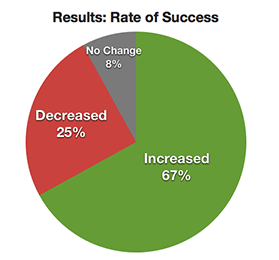
- 67% of subjects measured higher breast milk production on the final breast milk production test (Day 14 of ingesting Lactiful Supply Max) verses the control production test prior to starting Lactiful Supply Max.
- 25% of subjects measured lower breast milk production on the final breast milk production test (Day 14 of ingesting Lactiful Supply Max) verses the control production test prior to starting Lactiful Supply Max.
- 8% of subjects measured the same breast milk production on the final breast milk production test (Day 14 of ingesting Lactiful Supply Max) verses the control production test prior to starting Lactiful Supply Max. Each subject in this group measured higher breast milk production on at least one breast milk production test.
- Those subjects that increased their breast milk supply saw an average daily production gain of 14.8 ounces of breast milk per day. Those subjects that decreased their breast milk supply saw an average daily production decrease of 9.1 ounces of breast milk per day.
- The overall change in breast milk production for all subjects was a gain of 7.6 ounces per day.
An observational study was conducted from May 2012 to December 2012 to determine if there is a link between the herbal supplement, Lactiful Supply Max, and a change in breast milk production in lactating women.
An observation study design was chosen in part because the researches believe that a randomized controlled trial violates ethical standards. The link between better health and breastfeeding is well established and random assignment of subjects could lead to a higher incidence of formula feeding and increased illness in the control group.
Subjects were a subset of Lactiful customers who volunteered to take part in this research. Subjects were asked to complete 4 pumping tests that accurately measure daily breast milk production. Subjects who completed all pumping tests were issued a $50 refund by the company. Purchase of Lactiful Supply Max was a requirement of participation. Participation was voluntary and subjects could quit at any time.
THE BREAST MILK PRODUCTION PUMP TEST
Subjects were educated in the 4 hour pump test developed by researchers Ching Tat Lai, Post Grad Dip, M.Sc.; Thomas Hale, Ph.D.; Peter Hartmann, PhD.; and colleagues. This pump test gives an accurate measurement of how much breast milk a subject is generating in a twenty-four hour period. Subjects were given a worksheet which guided them through each step of the 4 hour pump test.
Subjects completed the 4 hour pump test four separate times in order to judge the effectiveness of Lactiful Supply Max on breast milk production. The pump tests followed this schedule:
Pump Test #1: Control test. (Before starting Lactiful Supply Max)
Pump Test #2: Day 3 of taking Lactiful Supply Max
Pump Test #3: Day 7 of taking Lactiful Supply Max
Pump Test #4: Day 14 of taking Lactiful Supply Max
The pump tests were conducted in the subjects' own home, using their own breast pumps which likely varied widely in quality and effectiveness.
PARTICIPATION
During the study we invited 518 Lactiful customers to participate. Of those, 76 signed up and completed at least one pump test. 36 completed all pumping tests in a satisfactory manner.
Subjects were asked if they had tried any other ingestibles (either herbal supplement or prescription medication) in an effort to increase breast milk production. 69.4% of subjects said they had tried an ingestible prior to Lactiful Supply Max, the most common being the herb, fenugreek.
Subjects who were currently using any product meant to increase breast milk supply agreed to stop for two weeks before beginning this study and completing the control breast milk production test.
RESULTS: RATE OF SUCCESS
When comparing daily milk production of the control pump test (before starting Lactiful Supply Max) to Pump Test #4 (day 14 of ingesting Lactiful Supply Max) the subjects showed these changes in milk supply:
- 24 subjects (67%) showed an increase in breast milk production.
- 9 subjects (25%) showed a decrease in breast milk production.
- 3 subjects (8%) showed no change in breast milk production. (However each of these subjects did show an increase during either Pump Test #2 or Pump Test #3 or both.)
It could be said that 75% of the women in this study saw an increase in breast milk production at some point while ingesting Lactiful Supply Max.
25% of subjects decreased their milk supply during the study. This is a significant number and deserves a closer look. As you will see in our conclusion, this study unwittingly attracted a majority (almost 70%) of subjects whose milk supply was resistant to treatment. "Resistant to treatment" here means that the subject tried other products for increasing milk supply but did not see an acceptable increase. Most of these women viewed Lactiful Supply Max as their last hope.
Given this, it is incorrect to say Lactiful Supply Max was the cause of these decreases. Here's why:
- A cause doesn't typically have two effects that are opposites. It is unlikely that Lactiful Supply Max can be both the cause for an increase and the cause for a decrease in breast milk production.
- Lower milk supply, especially a milk supply that is resistant to treatment, is a sign that the body is in the process of shutting down breast milk production. The more advanced the shutdown, the more difficult it is to reverse. There comes a point in the shutdown process where nothing can save it.
We hypothesize that the subjects who showed a decrease in their milk supply had reached a "point of no return" in the shutdown of breast milk production. We recommend that this hypothesis be examined in a follow-up study that compares decrease rates between a group that ingests Lactiful Supply Max and one that does not.
RESULTS: CHANGE IN PRODUCTION
We looked at the change in breast milk production from 3 different perspectives:
- The entire group of subjects, irrespective of if they saw an increase or decrease
- Only those subjects who saw an increase
- Only those subjects who saw a decrease
Here are the changes in breast milk production from each perspective:
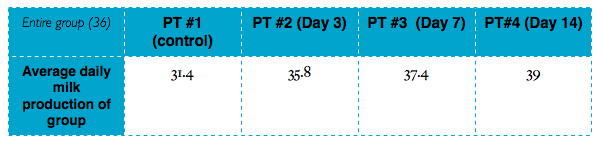
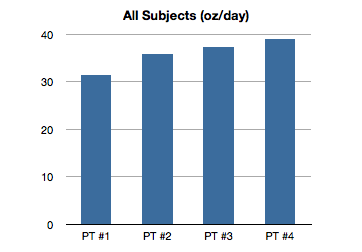
The group of all subjects increased their daily milk production by 274 ounces in 14 days of taking Lactiful. That's an increase of over two gallons per day across the 36 women. The average daily production gain was 7.6 ounces per woman per day. The percent increase is 24%.
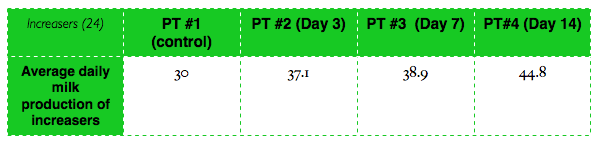

When looking at just the women who increased their milk production this group increased daily milk production by 355 ounces in 14 days of taking Lactiful. That's an increase of two gallons, three quarts per day across 24 women. The average daily production gain of 14.8 ounces per woman per day. The percent increase is 49%
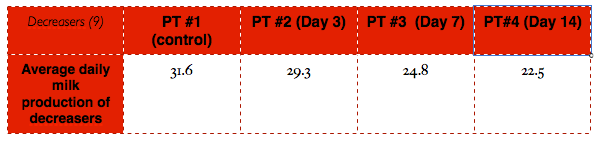
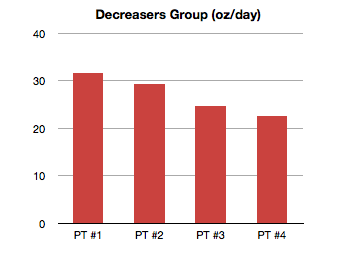
As a group the Decreasers decreased their daily milk production by 81 ounces in 14 days of taking Lactiful. Or an average daily production loss of 9.1 ounces per woman per day. The percent decrease is 29%.
CONCLUSION
Clearly there appears to be a significant link between Lactiful Supply Max and an increase in breast milk production.
These results are particularly remarkable because most subjects (almost 70%) said that they had tried at least one other ingestible that was marketed as increasing breast milk supply. We can conclude that these subjects did not experience a satisfactory increase from these other ingestibles. and in fact we termed these subjects as "resistant to treatment."
What is remarkable is that 68% of subjects that were resistant to treatment saw an increase while taking Lactiful Supply Max! The important point is that this study unwittingly attracted a statistically significant number of subjects who's milk production had shutdown so completely that other products could not correct it.
That Lactiful Supply Max can be linked to a significant increase in breast milk supply even when a majority of the subjects were resistant to treatment is a point that shouldn't be missed.
* DISCLAIMER: The claims on this page have not been evaluated by the Food and Drug Administration. Lactiful Supply Max is not intended to diagnose, treat, cure or prevent any disease. The information on this site is for informational purposes only and is not intended as a substitute for advice from your doctor or other health care professional. You should not use this information for diagnosis or treatment of any health problem. You should consult with a healthcare professional before starting any supplementation program. Because there are many causes of low milk supply, actual results of Lactiful Supply Max vary from person to person. If you try Lactiful and are not happy with the results in any way, you are protected by The Lactiful Guarantee. You may return Lactiful for a complete refund at any time, for any reason. See our Guarantee page for complete information. Website ©2009-2016 Lactiful LLC, all rights reserved.